Notes from the Festival of Grassroots Economics

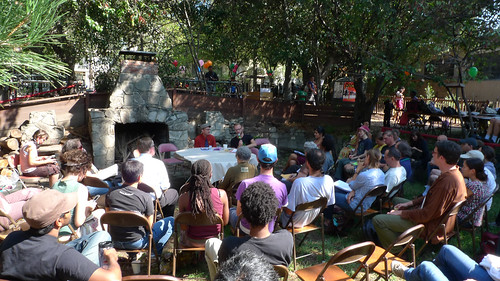
Panel at the Festival of Grassroots Economics

The Festival of Grassroots Economics was last Saturday in Oakland, organized by JASecon. I think it was a big success and so I congratulate Bernard Marszalek, Rick Simon, Heather Young and many others who worked hard at making this event a reality.

There were several remarkable things to this event. First, it was truly completely grassroots, organized by activists, non-profit workers, coop workers and related professional, and with them presenting. Second, it was free for all, which is sadly rare for an event dedicated to change. Last, it was organized in the beautiful setting of the Humanist Hall in Oakland with colorful decor and quotes on the walls such as “The world is my country, to do good is my religion” – Thomas Paine.

Many interesting ideas were discussed but I think the most interesting and realistic one related to small business local investing: how can small business, even coops can open their capital without spending a fortune and staying true to their values, instead of getting in debt, and ultimately how do we realize the vision of a small business local stock exchange. How can people take Warren Buffet “invest in what you understand” literally, and sell their mutual funds invested in large corporations such as McDonald’s and instead invest in funds that invest in businesses they know and shop at.

Behind all the discussions, I think the main theme was: how do we give small businesses and ultimately worker-owners the same tools that large corporations enjoy? how do we use the system to change the system?

The panel on the various styles of coops was particularly enlightening to me: some coops do not allocate shares democratically, but are run democratically, others provide each employee with the same number of shares when they start working, some others (big ones) hire professional managers with a separate compensation package, etc. The common thread though is that responsibility and decision-making is shared equally between all employees.

In a later fun discussion on leveraging legal loophole (which one may call “legal hacks”), a lawyer discussed how a coop can use preferred shares to open the capital, while keeping all voting rights. Another good legal hack is for a non-profit to create a for-profit subsidiary to reap the solar panel tax benefits reserved for for-profit companies.

One thing I missed at this event: art/play as an engine of economic renewal.
The great inflation/deflation debate and a message of hope

The inflation/deflation debate is raging. On one end, inflationists who are arguing that the increase in base money supply will inevitably transform itself in lost purchasing power of existing money via higher prices on the street. On the other end, deflationists who argue that in a credit based system, money is created through loans out of thin air (savings are created out of loans, not the reverse), which means that if the system has reached peak credit – no one can take on more debt – the only way out is through debt cancellation. If you are interested about this debate, I recommend the following excellent pointers: recorded debate, as well as this article and video.

In a recent twit, I said:

Continuing debt reduction implies conventional money will buy less of what we really want and more of what we don’t need.

I agree this is a bit cryptic, so I wanted to explain myself.

By debt reduction, I mean people either paying their debt down or walking away from their debt or having their debt being official forgotten. To understand what I mean you must understand that money is fundamentally about power: power to get people who want money to do whatever those with money want. Many people have this power and many others want what these people have. But not everyone can have power over everyone else. Certainly, it is not very motivating to realize that you will never ever get any of that power, while others get it by playing in the market casinos. So attitudes are changing and people will carry less and less debt. This is why I say: as debt is repaid or written off or not paid at all, there is less money in the system, hence less power to get others to do whatever we want. To get others to do something for us, in particular to care about us, money will be increasingly not enough, instead we will have to prove to them that we have done something of value to someone or something that they care about. This is why I say: “money will buy less of what we really want”. What we want is to be acknowledged, to belong, to be cared for, to be loved. All kinds of things money will buy less and less if deflation continues, and to me, this is a good thing.

On the other hand, because we live in such a productive economy, we have a potential for more abundance of what everybody needs for everyone. I am convinced we can thrive, feed everyone, lodge everyone, entertain everyone, etc. In other words, all these things we don’t need in excess (but are produced in excess and maintained in artificial scarcity). This is what I mean when I say that money will buy more of what we don’t need.

What will motivate people to do their best? because they will do what they love to do most and because they will know how well they do by getting acknowledged by those they care about for it on their social network or the whole Web.

So to conclude, I’m not too preoccupied with the concerns of the investment community whose is fundamentally scrambling to determine how to preserve the power of the wealthy. Having some savings myself, I was concerned like everyone else but my intuition tells me that there is not much one can do: anyone with anything that resembles idle money will lose some power in this deflationary process, and from that standpoint I agree with inflationists who worry about lost purchasing power. Equities, cash, gold, bonds, etc. will matter less and less until a balance between the market economy and the gift, reputation-based economy is found. The Web is deflationary and there is nothing we can do against its force. Aside from a diversified portfolio of assets, what one with assets really have to do is to put these to work while they have value to others to help change the system for the better, doing what they do best for the people and the things they truly care about.

Interview of Michel Serres (excerpts)

Les Echos, a French financial newspaper did a great interview of philosopher Michel Serres on topics related to money, governance and institutions. The automated translation is poor so I decided to translate some excerpts.

Society prefers money to its children

[…] This financial crisis is just one of several lights that turned red […] I don’t see any place in our living space that isn’t in a crisis as deep as the one you mention in the financial and economic world.

[…] Are you aware of the collapse of knowledge. We don’t teach latin or greek, poetry or literature. The teaching of science is collapsing everywhere.

[…] Philosophers are guilty. They have missed the magnitude of changes in the world. […] I see all institutions are true dinosaurs.

[…] Our relation to our planet is a one of terrorism. We are currently winning this war against the world, that is to say that we are losing it.

[…] I’d like to talk to you about why dinosaurs disappeared. We love to discuss the reasons why they died. But it’s very simple: they disappeared because they were growing. It’s their size that killed them. Life cannot exceed a certain size. We die of growth. […] Romans were victim of their greatness. The size of the Roman empire had become so big that it could only collapse. […] In the history of sciences, we see that there are topics that are a center of gravity at a given time. Before it was mechanics, tomorrow it will be life sciences. Tomorrow, the economy will be centered around life sciences, not mechanics.

[…] All the laws that we want to do with copyrights on the Internet are a joke. The Internet is a space without any Law. In this space without Law, a new kind of Law must emerge. In the world of tomorrow, a new type of Law must emerge. If you want to regulate the world of today with old Law, you will fail, just like we did on the Internet.

[…] (We need a contract with Earth) That’s what I meant when I wrote Le Contrat Naturel. (I cannnot imagine an international organization writing this new Law). I remember a discussion with the previous UN Secretary Boutros Boutros-Ghali. He was telling me that every time he talks about water, everyone tells me that they are not here to talk about water but to fight for the interests of the country they represent. As long as there will be intergovernmental organizations, the Earth will not be represented. […] We discuss fishing quotas while fishes are disappearing. Fishes do not have the right to speak. I am for this utopia that fishes would have a right to speak. I want a world institution that represent water, earth, fire… life. We need scientists who swear not to represent a country, an ideology, a corporation… and who represent fishes, air and water. International institutions are populated with dinosaurs.

The Engagement Economy

The Institute For The Future published a report in September 2008 about the Engagement Economy. Here are some excerpts:

what will most likely emerge as the most powerful currency in the economy of engagement? Emotion. The economy of engagement is also an economy of feelings, in which positive emotions—pride, curiosity, love, and feeling smart—are the ultimate reward for participation.

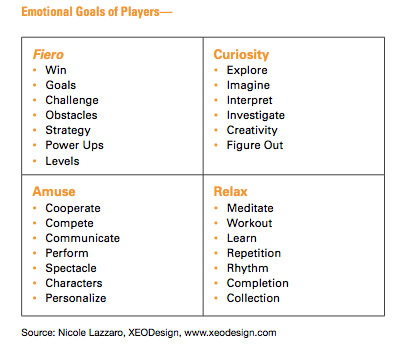
Emotional Goals of Players

Economist Edward Castranova, who studies massively multiplayer online games […] argues that most players turn to games specifically to produce the emotional high associated with accomplishing something concrete, feeling capable, and being recognized for their successes.

[…]

Shirky, too, confirms that the pleasures of accomplishment and the feeling of competence are basic drivers of participation in online communities.

[…]
PARC researcher and MMO expert Nick Yee discovered three primary motivations for MMO participation:

  • achievement, the desire to advance in the game’s hierarchy, master its mechanics, and compete against other participants;
  • social, the desire to have positive interactions with other people and work toward a common goal together;
  • and immersion, the desire to exercise imagination, consume compelling content, and think about something other than ordinary, everyday wor

Here are two books that I’ve read that relate to this: