Crescent City wood token

Yesterday, I found myself explaining the concept of local community currency to someone who had never heard about them before. Because we were next to a farmers’ market, I picked that context to support my stories about the benefits of local community currencies.

I built upon the story of the Taft Farms local currency, in which a farmer issued his own money to raise funds for the winter, and I explained that a farmers market could create a bank that would issue paper money redeemable only at the farmers market the following year, possibly at a discount (ex. $9 for $10 face value) and use the cash raised to provide credit to farmers in need during the winter season.

Additionally, the farmers market bank could promote itself by donating some of this paper money to non-profit organizations of its choice in exchange for ads for the farmers market in promotional materials issued by the non-profit organizations. Non-profits could follow the Community Way and sell this paper money at auctions to raise funds in real cash.

Last, I explained that the farmers market currency might be denominated in a different unit than the US dollar, say a “basket”, which composition would be defined by the farmer’s market every year. You could buy today baskets and use them as an inflationary hedge if you are a regular customer of the market and are worrying about your fiat national currency losing purchasing power over time.

Today, I found that some of my examples are not that far-fetched from reality.

The Farmers Market in Venice, CA has a program, which is very similar to Community Way: it offers certified market money subsidized by vendors to the organizations of their choice in exchange for mention of the donation in the printed materials of the events organized by organizations receiving donations. Organizations can use this market money to purchase good or auction them off to raise funds for the organization.

I also found two cases of farmers market tokens used as cash alternative: Crescent City Farmers market and Portland Farmers Market both provide a way to buy at one time batches of wood tokens that can be used as cash on the market. This is actually provided as a payment facility for those who want to shop with their credit card at merchants on the market not accepting the, but it could be easily extended to support the scenarios presented above.

[Slashdot] [Digg] [Reddit] [del.icio.us] [Facebook] [Technorati] [Google] [StumbleUpon]

From the Untergunggenberger Intitut Wörgl blog in Germany Austria, here is a video on the Palmas community currency in Nord-east Brazil, launched several years ago, which has enabled this impoverished community to build and retain wealth locally. Just to give an idea of the scale, Banco Palmas has 2100 associates… 60% of which are below the poverty line.

A very detailed description is available. Here are the specific points I noted:

  • Banco Palmas, which was started and is managed by local residents, functions as a local credit union that issues low interest rate loans in the alternative currency, the Palma, and provides also a credit card for payment convenience.
  • Access credit does not require documents, but only requires that local resident voucher for the loan. In other words, instead of relying on high-tech PhD risk analysis algorithm, CDS, securitization, and the likes, credit risk analysis is socialized.
  • The bank funds consumption and production reports to be able to better determine what is needed by the community and provide market research for entrepreneurs.
  • The alternative currency, the Palma, is backed by the national currency, and convertible at a 1% fee.
  • The bank has established partnerships with local businesses, and many are providing discounts when paying in Palmas.

Here are also some amazing numbers from the report:

  • In Ceará, sales in commercial establishments in the community increased by 40% In Ceará, sales in commercial establishment in the community increased by 40%
  • Bankruptcy for local businesses involved with the Bank has never exceeded 3% Bankruptcy for local businesses involved with the bank has never exceeded 3%
  • Crime rates in Ceará, compared to other neighborhoods in the city, are 5-6% lower Crime rates in Ceará, compared to other neighborhoods in the city, are 5-6% lower
  • 900 new jobs were created in the formal and informal sectors since the beginning of the project 900 new jobs were created in the formal and informal sectors since the beginning of the project
  • Of Banco Palmas clients, 82% feel more responsible; 95% consider the Bank an agent in the eradication of hunger and promotion of jobs and income; and 54% feel more solidarity with the community Of Banco Palmas clients, 82% feel more responsible; 95% consider the bank an agent in the eradication of hunger and promotion of jobs and income, and 54% feel more solidarity with the community
  • 11 other municipalities are currently receiving training from Banco Palmas technicians to implant community banks in their cities 11 other municipalities are currently receiving training from Banco Palmas implant technicians to community banks in their cities

[Slashdot] [Digg] [Reddit] [del.icio.us] [Facebook] [Technorati] [Google] [StumbleUpon]

From Wikipedia:

Bartercard is the world’s largest barter trading exchange. Bartercard enables member businesses to exchange goods and services with other member businesses without using cash or cash equivalents, or having to engage in the direct two-way swap of goods and/or services. It was established in Australia in 1991 and operates in over 13 countries with a member database of over 55000.

Members earn Bartercard Trade Dollars for the goods and services they sell and this value is recorded electronically in the member’s account database.

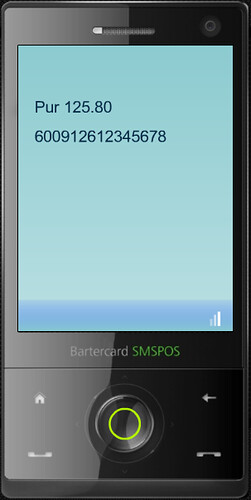
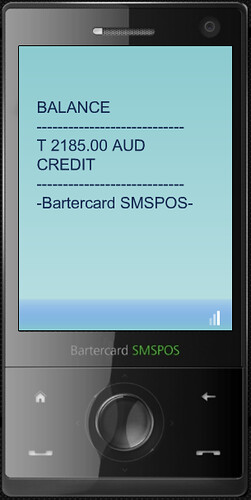
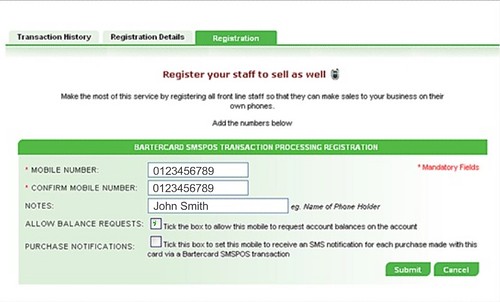
In January 2008, BarterCard introduced a SMS-based service that allows merchants to process transactions immediately with funds being transferred into their account at point of sale. The service also supports balance inquiry. The user guide can be found here. I also put some screenshots below from their online demo.

Although the balance inquiry is pretty standard in mobile banking, the SMS-based POS transaction processing is I think really unique.

To process a sale to a BarterCard , the merchant simply types “Pur [Amount] [BarterCard number]“, sends it to the BarterCard phone number (saved as contact) and if the transaction is successful, receives a 10 digit reference number composed of a 4 digit BarterCard SMSPOS reference number and a 6 digit BarterCard Authorization number.

Of course, one might ask the kind of protection provided against fraud and the user guide only mentions:

We do advise you that you retain a proof of sale from the purchaser in the form of a signed receipt of invoice. If the sale is ever contested, you will be required to provide this proof.

The other security feature is that at registration, members can register to be notified whenever they make a purchase that’s processed via the SMSPOS service (as opposed to processing a purchase).

So, what’s interesting here is that a very low-tech solution in terms of fraud prevention. It seems that fraud policing is done by members and resolved by BarterCard employees. It would be interested to hear from BarterCard about their fraud statistics, if any. This would be a great demonstration of how social capital can be used to prevent fraud.

Going back to the functionality of the SMSPOS service, there are two other advanced features:

  • A previous transaction can be retried by typing and sending “Retry [Amount] [BarterCard Number]“
  • A transaction can be reversed (1 hour window) by typing and sending “Rev [Amount] [previously received 4 digit BarterCard SMSPOS reference number], for instance “Rev 40.50 0022″.

Registration part 1

Registration part 2

POS Transaction Processing

Balance Inquiry

[Slashdot] [Digg] [Reddit] [del.icio.us] [Facebook] [Technorati] [Google] [StumbleUpon]

Interacting with Digital Money

December 10th, 2008

Chris Woebken has created some pretty curious new ways of interacting physically with digital or plastic money.

Chris Woebken Future of Money video

[Slashdot] [Digg] [Reddit] [del.icio.us] [Facebook] [Technorati] [Google] [StumbleUpon]

In May 2007, Civil Economics, an economics research company specialized in sustainable prosperity has issued a research note titled San Francisco Retail Diversity Study (Full Study
Executive Summary
Talking Points).

The main conclusion of the study is that

A 10% shift in consumer spending, from chains and internet to locally owned retail, would create nearly 1300 new jobs and over $190 million in increased economic output for San Francisco. Consumers don’t have to spend more, just spend differently.

Guillaume here: something not mentioned in the analysis is that more jobs and more economic output in a specific geography where you own a house means that your house increases in value (or keeps its value or decreases relatively less). In other words, by collectively chasing deals online and saving $100 in Christmas gifts, a neighborhood may be actually be contributing to a decrease in their wealth. It would be nice if the money system was making this link more obvious.

Anyway, it seems that Association of Alternative Newsweeklies heard about this study and launched a national campaign that

urges their readers to spend at least $100 of their holiday money this fall at locally owned stores in their communities – a move that could pump more than $2.9 billion into urban economies during this recession-plagued season.

(full press release).

In the Portrero neighborhood of San Francisco, local merchants have adapted the campaign into a drawing of lots for a prize whereby people can “buy” tickets for the chance to win gift certificates from local merchants by sending an email with a pledge to spend $100 locally.

Here is an example of the emails circulating.

The Potrero merchants are running a promotion, giving away $1000 worth of
gift certificates to locally-owned, independent businesses. The drawing is
this Thursday; all you have to do to enter to win is to pledge that $100 of
your holiday spending stays here in the neighborhood, with locally-owned
merchants.

Send an email saying “I pledge” to pledge@potrerohill.biz and you are
entered into the drawing. Someone will win $500 worth of goods and
services, and thanks to local merchants, there will be two 2nd prizes: $250
worth of goods and services.

So… think about redirecting just $100 that you might have spent at
Amazon.com, or Macy’s, or on Starbucks gift cards. And help the local
economy — find out more at www.potrerohill.biz

And please — forward this to others you know who live and work in Potrero
and Dogpatch. OK sure, it will slightly reduce your chances of winning the
drawing, but it’s great for people to learn more about our local
businesses.

Portrero Buy Local campaign

Guillaume here: I think this is a great step towards local community currencies. I think I would have liked the Portrero Merchant association to go a step further and let merchants issue merchant branded “Portrero Bucks” that merchants would have sold for real US dollars, with say $100 “Portrero Bucks” for $90 U.S. dollars. These would have acted as a guarantee for the pledge, and would have been a first step towards the creation of an actual community currency.

[Slashdot] [Digg] [Reddit] [del.icio.us] [Facebook] [Technorati] [Google] [StumbleUpon]

Chris Skinner just posted a new post on “Social Money” in which he writes about the challenges of online currencies or real-life complementary currencies. I commented at length and making a connection between currency independence and money independence.

Money is fundamentally social. Which is why the social Web can be expected to impact banking/payments much more than it has so far operationally. I personally view the monetary system we live in today as a sort of AOL of money where one central organization and its affiliates have effectively a monopole on what is money and how it is created. I think that at the time of AOL, people had a difficult time imagining what an open, decentralized and resilient AOL would be, and how much it would force them to transform. Today, in my opinion, we are in the early days of this new decentralized money. We haven’t figure it’s version of HTTP, HTML, browser, SSL and DNS yet, that’s all.

With regards to runs on communities’ money. I think it makes it very clear that an independent community with an independent currency should seek not just a 0 or positive balance of payments, but a balanced current account. As Paul Volcker (I think) said: “Trade matters”. The strength of a currency in other words depend on the resilience on the local economy to outside events. In the real world, free trade ideology and negligence of deficits has already cost some real countries dearly (Iceland) and many other countries including the US are at risk.

With regards to adoption of community currency, I would argue that it is not just a problem of trust. The success of real-life currency is not because people necessarily trust them. It is primarily because demand for it is created by making it the only to pay for tax debts. One way to create demand for a currency is to have local businesses (i.e. org/people with public reputation) issue it and have community member agrees that the non-profit community service entities get their donations only in this currency.

[Slashdot] [Digg] [Reddit] [del.icio.us] [Facebook] [Technorati] [Google] [StumbleUpon]

My submitted idea on Change.org

December 2nd, 2008

Change.org is a movement of citizens inspired by the presidential campaign who are now submitting ideas for how they think the Obama Administration should change America. It’s called “Ideas for Change in America.”

I’ve submitted an idea and I’d appreciate greatly if you read. If you like it, please visit my idea’s page on Change.org to vote for it.

Establish a Research Center on Money

Money is at the center of our economy and fundamentally shapes our relationships as humans and the value system of the society we live in.

Recent financial, ecological and humanitarian events have increased popular intuition that there is something wrong with our current money system itself, and that policies will have limited impact unless the money itself we use is changed.

History has shown that money can exist in various shapes and forms. Some grassroots efforts in many communities in the U.S. and outside the U.S. have shown that alternative/complementary community money is a powerful way to increase local wealth, increase social capital and keep economic activity going in times of recessions/depressions. Last, technology advances such as the Internet, open security and collaborative development efforts have made it easy more than ever before to create new forms of electronic money.

Yet, there is little scientific research, whether theoretical or empirical, available on alternative forms of money, whether based on units of sustainable energy, hours of work of people, online reputation, or commodities.

A Research Center on Money would fund scientific economic research on alternative/complementary forms of money and how they can benefit our communities from neighborhood to cities to counties and states. It would be a tremendous resource for communities to confidently start using money as a powerful tool for change.

[Slashdot] [Digg] [Reddit] [del.icio.us] [Facebook] [Technorati] [Google] [StumbleUpon]