What a personal data currency may look like

I was challenged tonight in an email to explore where VRM and Open Money concepts may intersect.

Here are my notes:

  • To make personal data a currency, you would have to issue redeemable promises to deliver personal data to anyone “holding” the promise, say your location.
  • You may want to assign circulation rules to your currency so that it has no value outside of your social network (and you don’t end up being stalked by strangers).
  • Until redeemed by you the issuer, the currency could be exchanged for goods/services.
  • After redeeming the promise i.e. obtaining the data from the currency issuer, the promise would no longer have any value.
  • To have significant value, the currency would have to be issued by you (and ideally, certified by other parties).
  • You may want to provide foreign exchange services.

Of course, I haven’t answered the key question yet: why anyone would want to make their personal data a currency.

Evolving community currencies from barn raising

The biggest challenge of community currency adoption is probably education. People don’t understand why they would need a different currency, or they don’t trust the community currency as much as the government-issued currency.

Over at the opensourcecurrency group, Benjamin made a very exciting suggestion based on an adaption of the Amish barn raising.

With Barn Raising, we all get together
in January and break up into groups of 4-6 households. We then
schedule our work days – about one every other month – throughout the
year. When your day comes up, everyone converges on your house and you
put them to work for the day. It’s a great way to get big projects
hammered out in a short amount of time, and it’s way fun! The problem
is that anyone who doesn’t get in during that first meeting has a hard
time joining a group. I see ATEN as a way to facilitate even more of
the BarnRaising spirit without having to do all the organization up-
front. You have a bunch of folks over to your house and then pay them
in hours. Go to someone else’s house and get some of that time back
working for them, etc.

So, the idea is essentially for the community currency, here time-based, to be used as a tool to make the barn-raising more flexible.

What I really like about this idea is that it makes the community in community currency very real in a social sense: you get to meet and accomplish something with other community members.

An analysis of the CommunitySmart fundraising and loyalty program

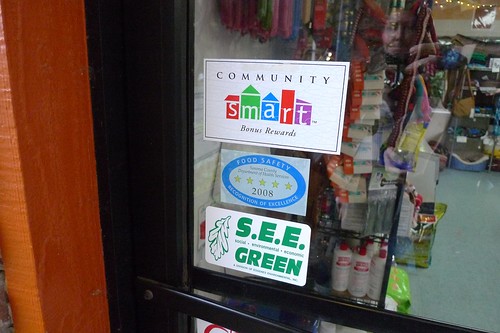
While on a WE in the Russian River area, 2 hours north of San Francisco, my payment-obsessed eye noticed a “Community Smart Bonus Rewards” sticker on the entrance door of the Food for Humans organic supermarket.

CommunitySmart Bonus Rewards

Back home, I researched this program and found out that Community Smart Bonus Rewards is essentially a merchant-funded local fundraising program for local non-profits and community services like schools. Participating merchants set a rebate, participating customers choose a school or charity in their community that they would like to support, and for each qualifying transaction the cash value of the rebate minus a small administration fee is paid to the chosen school or charity. This reminded me a lot of Community Way, except that in Community Way, rebates are re-circulated as local currency, so they have a multiplier effect.

Merchants decide how to structure their rebates. The most common seems to be an amount or percentage based on a minimum purchase amount with an optional capped amount on each rebate, but many other options are possible:

  • a flat dollar amount,
  • a fixed percentage of the purchase amount,
  • a tiered percentage of the purchase amount,
  • an amount that is available on certain shopping days or promotional periods.
  • a special percentage or amount (to override a normal percentage or amount) on certain shopping days or promotional periods.

Participation in the program only requires merchants to have a POS terminal, and only requires customers to have either a Community Smart-registered credit card, or a CommunitySmart program card (shipping/handling fee $4.95) for customers who wants to pay by cash or check.

When paying by cash or check, customers slide their CommunitySmart program card in the POS reader. Because the card is not a payment card the payment is declined, but the information about the purchase and the amount is recorded. This method of capturing customer transaction data by routine declining of authorization requests is the core patent of Nietech, the company supporting the Community Smart service.

Nietech is a Santa Rosa, CA-based company.  According to this bizjournals.com report, their annual revenue is $750K. According to this article, they are a 14-people operation with among other customers, the Interra Project, a social commerce non-profit started by Dee Hock, founder of Visa International, and Greg Steltenpohl, founder of the Odwalla juice company with the goal to harness consumer power – 70 percent of the Gross National Product – for social change…

I haven’t had enough time to find much information about the current status and success of CommunitySmart or Interra. In 2005, Nietech reported having raised $75K for a local school in partnership with a local bank issuing their CommunitySmart card, but I haven’t found any news about a successful national roll-out. Similarly, Google News does not have much news about Interra Project in the last few years. I didn’t have much time to research and may have missed news, so if you have any information about these projects, please comment.

Good Banking

I’m reading the live blogging of the Bernanke hearing today, and I’m pretty shocked by the following conversation:

Bad lingo | 3:59 p.m. Emanuel Cleaver, a Democrat from Missouri, condemns the term “bad bank.” He says the term does not exactly inspire support for the program. Maybe it should be called the “Damascus Road” bank, he says, or maybe the Fed should have a linguist look into something else more appealing.

Mr. Bernanke replies that it’s officially called an “aggregator bank,” not a “bad bank.”

Mr. Cleaver says that term is unlikely to catch on, and that perhaps a three-year-old should come up with something that rolls a bit more trippingly off the tongue.

Well, what about “Good Bank”, and what about making it more than just a sweet name?

I’m convinced Americans want good, ethical banking, the kind of banking that focuses on developing healthy communities where they can live and raise their kids. Just like anyone else on this planet. More importantly, they want HOPE, and good banking IS hope.

Bruce Cahan says it very well:

What We Had

The earliest banks were built by business, civic and religious leaders to grow hometowns, in regions they knew best. Community banks and bankers exist as a minority, often still independently-owned.

What We Lost

Today, most deposits (upwards of 80%) in America’s large cities are held by banks headquartered elsewhere, accountable to no one locally, except regulators in Washington or the state capitols who are easily outmaneuvered through lobbyists, industry political donations and complex financial instrument structures that camouflage the transparency needed to see simple causes and effects.

America’s banking system has lost its roots, has lost its way. “Safety and soundness” used to mean bankers living in and knowing their home regions and the people, businesses, governments and nonprofits there. Now Wall Street financial services mega-banks and investment professionals have fractionalized underwriting, ownership and obligation to the point where hedged bets on leveraged obligations (e.g., home mortgages or corporate bonds) create a rapidly cascading morass of multiplexed risk, drying credit up for other purposes in places where the risks are less or could be underwritten more safely and simply. As rogue traders have shown, the whole house of cards can easily unravel, with the use market capitalization and Federal Reserve costs unwinding such positions entails.

What We Need: An Ethical Bank

We need more ethical banks, where decisions are made transparently, its allegiances trace back to community concern and its pricing of credit and investments is directly tied to the contribution each transaction makes to growing regional health.

Hayes Valley Money (report from the field) and Play it Forward Akoha cards

Hayes Valley Money

From wikipedia:

Hayes Valley is a neighborhood in San Francisco, California, between the historical districts of Alamo Square and Civic Center. Victorian, Queen Anne, and Edwardian townhouses rub shoulders with boutiques, restaurants, and public housing complexes.

In November 2008, to fight a worsening recession, Hayes Valley started to print their own money with the Hayes Valley Money rewards program. Here’s how it works:

shop at any participating merchant for a chance to win a Hayes Valley Money card good for $5, $10, or even $20! You can use your reward card in the shop where you got it or at any other participating store. Just look for the “money card participating merchant” signs in store windows or refer to the list below. Hayes Valley Money rewards cards are good for 30 days

This is currently a very low-tech endeavor: to prevent forgery, the money cards are signed by hand by each merchant at the time they are given to customers, together with the expiration date. “We are currently 16 merchants participating in this program and we all know each other, so it would be very hard for someone to forge” explains Russell Pritchard of the Hayes Valley Merchants Associaton.

Russell explained that so far, he has been a bit disappointed by the number of merchants joining the initiative (16 so far), but he has been really encouraged by the reception from customers. So far, out of the 30-40 rewards he has given out, only several came back from other merchants, most likely because people haven’t used them. He may typically give a $10 reward for a $100+ purchase and may a $20 reward for a $200-500 purchase. But he said, and this is interesting, that it happened that he actually gave away some of them to some people he knows shop locally or were considering buying a piece of his store.

From a “backend” standpoint, the rebate collected by merchants are simply counted and returned to the issuing merchant. Rusell acknowledged that the easy-to-setup adoption of a paper/signature-based system has drawbacks in terms of tracking and clearing between merchants, but it’s a start.

Russell hopes that this initiative will be duplicated all over the city with the support of the city of San Francisco. He personally handed a rebate card to mayor Gavin Newsome, who has been personally supporting local shopping during the holiday season, and recently reminded him that he hadn’t used it yet.

My comment

Because the rebate issued is not re-circulated after it has been used once, we cannot strictly talk about a currency (currency comes from current, something that flows). In the current model, merchants are essentially injecting their own money into the neighborhood, creating an incentive for visitors to shop at more than one store in the neighborhood in a short period of time. I suspect this model might lead some of them to think that they might give more than others do.

The next step in my opinion would be to move to a real currency model where received rebates could be used by businesses to trade with one another. In this scenario, the rebates received by a merchant would not be returned to the issuing merchant, but simply used to trade with another merchant. It might not make sense in a community of 16 merchants, but if the community is big enough and involve a wide variety of business types, it will.

Still, there would be something missing in this model: no community value would be created. One way of doing so would be for merchants to donate some of their rebate cards to local community services that would be then use them to fund their activities by using them, or reselling them for hard dollars to local residents willing to make a donation, but without losing purchasing power.

Parallel with Play it foward Akoha cards

A tweet from @akoka picked my attention today. The original idea is for customers to thank each other with rewards cards and propagate good karma, but there is a possible connection between the Hayes Valley Money rebate cards and Akoha cards: stores could easily leverage the Akoha awesome tracking infrastructure to print cards, hand them out to customers, track through which users and which merchants they have been through.

If the merchants themselves play them forward, until the cards they issued are returned to them, as I suggested above, they could effectively measure how many transactions they have incentivized through their rebate cards.

Last, merchants could also easily connect with customers without ever asking them their email or contact information, since Akoha users typically register the card on their Web site to keep a tally of karma points they have accumulated by passing the card along.

The need for an Open Money Foundation

I’ve discussed this topic with Michael Linton and Marc Armstrong this WE.

Problem: community currencies are a $0 Billion market and promoting their development in a way that ensures and maximizes their potential for communities is expensive. Examples include travel costs or Web hosting costs. Today, although many parties are interested in the development of community currencies, there is no organization that represent their common interests that is able to officially receive donations for interested parties. These common interests today are mostly public awareness and technology interoperability, but will eventually include – should we be successful – right to exist under rules dictated by the government of each nation where these currencies are used.

Solution: we formalize Open Money into an Open Money Foundation, a non-profit dedicated to ensuring and maximizing the potential of community currencies. We use Community Way to raise money: corporate sponsors that may include telcos, computer manufacturers, airlines, etc. These companies donate to the foundation their excess capacity in the forms of consumer coupons/vouchers (ex. voice minutes, bandwidth, computers, offices, miles, etc.) and the foundation uses these donations to finance its mission either by directly using them, or by reselling them for the currency needed.