What would be the iPod of Financial Services?

7 years ago exactly today, Steve Jobs introduced the iPod, a 5GB HDD stylish music player.

Screenshot of launch video

Looking back, this was one of Apple boldest strategic moves and one of its most successful as well. It’s good to look back at the choices they made and wonder what the equivalent would be in the financial services world.

  1. They identified a large non-speculative market with no market leader (music).
  2. They laser-focused on a “quantum leap” value proposition: “your whole music library in your pocket” at a fraction of the TCO per song provided by other products.
  3. They chose the best technology they could find to power this value proposition: thin HDD, fast-charge long-lasting battery, and fast uploading FireWire link.

What could be a comparable innovation in financial services and where could it come from? Here’s my take.

  1. Large market: personal money management
  2. Quantum value proposition: complete peace of mind
  3. Technology: real-time access by the service provider to any financially-relevant information about you (expenses, assets, liabilities, goals, etc.) and automated creation of a sound and realistic plan.

I know some will strongly disagree with me, but my feeling is that just like the iPod didn’t come from an established music label/distributor, the iPod of financial services may not come from an established financial services provider (just like music labels/distributors, financial services providers are too busy these days to save their business models).

That does not mean it will come from a start-up either. The key will be to leverage an established trusted brand, and establishing a trusted brand requires much more than a top-notch team, VC money and unique technology and value proposition.

Looking at the consumer perspective, it seems to me that there is currently a stronger-than-average interest in trusting a single brand for a given problem, and leaving it to them to make the choices for you (and focusing on what you do best). Yes, Windows lets you decide where to put your application money, but for most computer non-geeks, less choice is more.

Financial Services are a bit like Windows these days. Many choices are offered but consumers feel they are left to decide what’s best for them in a world they don’t understand.

To come back to my comparison to the iPod, many consumers don’t want to have to know where to click, which audio file formats to use, which software to use, where to shop, etc. they just want to enjoy their music. I think a similar comparison could be made with money: most people don’t want to have to know where to invest, what to save, how big a loan they can afford, etc. They just want to know that whatever money they have they can enjoy the most today and tomorrow.

At a recent mobile conference (Mobile Web Wars), Michael Arrington said: “people are always willing to give away their privacy for value”. This is a thought that came back to my mind as I was recently reading Lending, with a Twist, an article describing one of Khosla‘s investments: On Deck Capital. On Deck essentially reduces the risk with loaning to small businesses by tracking their business on a daily basis, which is a much better measure than a credit score that is always lagging valuable creditworthiness information.

Reading about On Deck made me think that there was no similar financial service where consumers would voluntarily give their full past, present and future estimated financial picture to a third-party in exchange for true peace of mind. This could probably be done without even switching  completely away from existing financial services providers, just as companies like Mint.com or Wesabe allow you to get a better understanding of your finances without swithing to Mint bank or Wesabe bank.

But to bring true piece of mind, such a service would have to go much further than giving recommendations and it would have to be backed by a highly trusted brand, with a value proposition backed by a wide portfolio of investments giving it preferred access to a wide variety of goods and services. This type of peace of mind used to be provided by large enough corporations to their employees, but it seems that such a responsibility is to heavy to bear for any a single industrial company, so it would have to be provided by some sort of conglomerate (companies have put in place strategies to focus on what they do best, but ironically that leaves most of us with less time to focus on what we do best). I don’t really have any name in mind, but Berkshire Hathaway may be the closest one I can think about.

Is this a crazy idea?

Weighing alternatives to our current monetary system

Bank of England close up

As the financial crisis starts to unfold, there is an increasing intuitive understanding among curious people that the way our money system works is at the heart of our problems. As a result, there is a renewed interest  in the blogosphere in discussing alternative forms of currencies, either local or global. One particular post that caught my attention is from the TheOilDrum.com (found via Mendo Moola blog), whose most interesting part is actually the long discussion thread on the various options for alternative currencies and their respective merit.

There were a lot of good comments and I’ve tried to organize them a little bit.

My high-level conclusions/understanding after reading this discussion are:

  • We should have two separate currencies, one for speculation and investments and one for medium of exchange.
  • A fiat money for the medium-of-exchange money is not a bad idea. Backing it with anything, even clean Kwh or a basket of commodities will make it the best asset to own, which won’t contribute to its circulation
  • The one used as medium of exchange should depreciate by design
  • its issuance may be based on a decentralized measure of creditworthiness rather than on a relatively centralized banks-based creditworthiness
  • [This subject was not really discussed] A Full Reserve Banking system for the investment one might be a good idea, although a Fractional Reserve Banking system is somewhat more fault-tolerant and may encourage more risk-taking (when faults are limited, it is impractical as we know when faults all happen at the same time)

Here are my complete reading notes.

What is money and why we need it

team10tim says:

The fungibility of money is the sole reason that we, as a civilization, prefer it over barter. It reduces complicated situations down to a single common denominator. […] Money isn’t good or evil, it’s soulless.

ets says:

If you think of money as an extension of the barter system, then money actually represents the incomplete portion of a trade.

Later:

There are several perspectives on what the essence of money really is, but one is that a unit of money is a claim on a certain percentage of the total goods and services available in the market (a share, if you will). Another common perception is that “time is money”, or rather, vice versa. While the relation is not really that simple, there certainly is a time element to money.

Later:

The fundamental problem with money: Namely, that money is too good of an asset compared to nearly any other commodity.

On the benefits of separation and co-habitation of “medium-of-exchange” currencies and “store-of-value”/investment currencies

One recurring point in the comments was the fact that a currency being both a medium of exchange and a store of value is problematic. Both should exist separately and conversion facilities should exist.
Steve from Virginia says:

In the West, the ‘single function’ currency allows non-productive speculative claims to be made against productive parts of economies. This is a serious flaw in the single function regime. […] The dual currency idea is one I’ve had for a long time; one ‘hard money’ convertible ‘Gold Dollars’ that would be useful for saving and productive investment and a second ‘fiat money’ non- convertible (electronic) currency that would be used for financial speculation.

Doom and Gloom Dad:

I don’t think you want to back up a local “medium of exchange” currency directly with a “store of value” currency

ets says:

Currency should be a transport for value. Using currency to store value would be like using a cargo ship as a warehouse. My opinion is that currency should not act as a store of value, there are innumerable commodities that can serve that purpose. Currency, on the other hand, should be designed to do one thing particularly well: circulate. In my mind, I think a paradigm shift regarding money is necessary. It should not be seen as an asset, but rather a shared resource. By holding onto it you are depriving others of its use.

etc says:

It seems to me that it is often overlooked that the two most commonly cited attributes of money are mutually incompatible. Those attributes being: a medium of exchange, and a store of value. That is, when something is being exchanged it is not stored, and when stored cannot be exchanged. So the more money that is stored, the less is available for exchange (a.k.a. commerce). This is, to me at least, a very important point, and is one reason I prefer demurrage based systems.

On the benefits of money whose value depreciates

This discussion only applies to medium-of-exchange moneys, obviously. The basic idea is that if it does not depreciate, then it is kept and hoarded by those citizens that are most productive, until they own all the money, which they can lend and essentially control commerce.

Jokuhl says:

if your money is quickly depreciating, you would use it to get not only essentials, but in a more long-term frame of mind, to use these earnings to invest in Real long-term assets. Durable Products, things that would retain their value. This should have the effect of minimizing the resource usage we see today, where we buy the cheapest stuff, and as it dies quickly, are constantly replacing our belongings, using up resources at this deadly pace.

ets says

As to inflation being equivalent to demurrage; that is only generally correct. I don’t think inflation itself is the problem, but rather the unpredictability of the inflation rate. Also, the inflation effect varies for different segments of an economy, distorting price signals, and making the “inflation tax” not very equitable.

Also, later ets says:

My opinion is that currency should not act as a store of value, there are innumerable commodities that can serve that purpose. Currency, on the other hand, should be designed to do one thing particularly well: circulate.

On interest

etc says:

The idea that money would not be lent without positive interest is based on the perception that money is a reasonably good store of value. If money were to devalue on a relatively short time scale, one might find that the borrower would be considered as providing as much of a service as the lender.

Issues with local currencies and solutions

Doom and Gloom Dad explains that one of the major issues with local currencies is that it is an economic service that is provided for free, and as a result depends on donated time, money and resources and inevitably results in the burn out of the organizers.

Issues related to the backing of money

ets says:

Commodity-based currencies artificially inflate the value of the backing commodities. Additionally, dealing with commodity variety and grades is problematic. An energy unit would surely be my choice for any “single” physical backing. However, I think it would better to back a currency with a basket of all the goods and services produced by mankind in proportion to their marketable quantities. In other words, an arbitrary unit such as “dollar” should suffice. ;-) [In other words] I do not advocate commodity backed currencies, with a basket, or otherwise. My comment was intended as tongue-in-cheek, the basket being comprised of “all goods and services”, clearly an intractable problem.
Gold bugs: gold does not have any significant “intrinsic value”. Its value was declared, essentially by fiat, a long time ago… Its value is determined the same way the value of anything is determined; by what someone will give you for it in trade.

Doom and Gloom Dad says:

The backing commodities tend to be produced for their monetary status rather than their more normal utilities. One cannot really get away from that with a basket of commodities. It may take a bit of analysis to see that. Even a very extensive basket of commodities puts an emphasis on commodities over services.

Issues related to the creation of money

team10tim says:

Whoever controls the money supply will have substantial control over the economy. Whoever receives the newly minted money is going to enjoy primacy. The question is how do we allocate that primacy? How do we enjoy the fungibility of money and retain control over values in the ethical sense?

According to Doom and Gloom Dad, there is no issue of money creation but an issue of creditworthiness of each participant:

Barter credits come into existence when a transaction is performed: One person’s account is augmented by the exact amount by which anothers is diminished. The sum over all accounts is at all times zero. It’s sort of like electrons popping up and leaving oppositely charged holes in a semiconductor.
Thus in a sense, there is no money supply. “How do we create money responsibly?” I believe that this is a responsible way of creating money.

ets replied with a very good point:

how much money is in a LETS system? It is not zero. The net system balance is zero. Simply because positive balances must equal negative balances by design. The money supply is actually the maximum amount of negative balance permitted in the system. If there were no limit to negative balances, the money supply would be infinite.

Gasoline as money

1979 Gas coupon

Ever since I’ve read about the use of prepaid mobile recharge vouchers as alternative currency in some inflationist countries of Africa, I’ve been wondering what could be the equivalent in the U.S. should the dollar currency lose its value.

The obvious took some time to come to my mind, probably because I’m not a big user of it myself: gasoline.

Gasoline comes indeed with several properties that make it a very practical alternative currency:

  • It’s an excellent store of value:
    • consider that the value of being able to drive your own car to work everyday has the same value to you whatever the price in U.S. dollars the gallon is.
    • if you intend to use gas as currency to purchase non-gasoline items, and although oil prices in dollars have recently come down from their peak, the risks to the price in U.S. dollars going up in the next 5-10 years are much higher then the risk to go down.
  • It’s an excellent standard of value: just like most people know what a dollar gets you, most people know the value of 1, 10 or 20 gallons i.e. how many miles i.e. how much mobility they can get out of each gallon.
  • It’s a potentially excellent medium of exchange: unlike gold or U.S. dollar bill, it has intrinsic value for most of us car drivers.

The only problem with the last bullet is that it’s not easy to bank gallons and transfer them from account to account.

Several companies have started to work on something close to this “gasoline banking” capability:

  • Fuel Bank‘s Web site says that they will soon offer a “Fuel Card” they can re-load online to lock-in gas prices, and then use this card in participating gas stations, as well as transfer gallons from account to account. When the service will be available is unclear.
  • MyGallons.com plans to also offer the ability to lock-in prices and use them later. The company’s CEO explains that the service’s launch has been postponed.

I’ve also stumbled upon this patent about a Prepaid gasoline transaction platform, which could support the concept of “Gasoline as money”.

The recent decline of the price of oil has probably reduced the interest in these companies, but if the dollar depreciates and/or if the price of oil resumes its inevitable long-term trend, or if other geopolitical events reduce the amount of cheap gasoline imported in the U.S., these projects may get back some of their momentum.

Semantic Marketing

Scott Brinker has a great article on the role of marketing in a semantic Web world.

This is a very valid question, since the semantic Web world will IMO mark the end of the “destination” Web and the advent of the “me” Web: I don’t need to go to any Web site to get my information, it gets instead aggregated and filtered out of the junk I don’t want to see in the format I enjoy to consume it the most, one of the filters being the reputation I have of the author of the content as weighted by each member of my social network.

I agree with Scott that good semantic marketing will start with good, and accurate data and metadata about products/services, good distribution in particular via compliance with various established publication standards (microformats, RDFa, etc.).

If I’m correct on how data relevancy will be established by leveraging your social network, SEO will essentially become the old name for “Reputation Engineering” or “Reputation Hacking”. The more reputation your company has in a given social network, the more it will top query results.

In terms of ads, since we are left with a single destination that one can see as the next-generation RSS reader, I see two models:

  • Contextual ads next to the content/data my collection of queries is typically retrieving. This is similar to the ads you have in Google Reader.
  • Suggestions (similar to Google Suggests) as I’m creating my query in my semantic query builder, companies pay for certain categories of products or names to show up higher in the list (imagine a Google Suggests where companies can bid to push words higher in the list of suggested items).

The crisis and scaling problems to an understandable level

Very picturesque comment over here at Naked Capitalism.

Congress has Constitutional authority to resolve all the issues involved in the crisis, it just hasn’t had the political will to decide whose oxen get gored to feed the village. But if the village gets hungry enough, Congress will be pressured into deciding how people share the losses, be it directly through default, or indirectly through taxes or inflation.

I can’t judge for the validity of this statement, but it reminds me that scaling these global problems to a level that normal types can comprehend and relate to would be a great way for our government to communicate about the crisis we are facing (and ideally before we face it). How can someone figure what $700B or $10T is?

After all, this is all about confidence and the less people understand, the more they will shoot first and ask later.

Swirrl.com: collaboration tool for semantic data

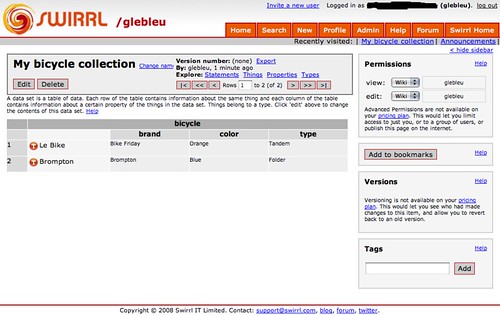
Swirrl is pitched as a “data collaboration tool”. It’s essentially a wiki with support for tabular data. So people can create tables of data and collaboratively edit them. It reminds me of DabbleDB.

The wiki part is not very interesting. It has a TinyMCE WYSIWYG editor that makes it easier for users with no knowledge of traditional wiki syntax. The interesting part is the ability to create data sets of things of a certain types with properties of a certain type.

Here is an example:
Swirrl screenshot

According to this article, Swirrl’s goal is fill the void between spreadsheets of data sent around, which are very flexible but poor for collaboration, and highly structured databases and applications, which are good for collaboration but highly inflexible.

According to the same article, Swirrl is based on RDF, which should be good news for querying. Unfortunately, I couldn’t figure how to build queries on my data set.

I absolutely agree with the Swirrl team that there is a big need for easy-to-use collaborative tools that allows to combine unstructured information and structured data. The approach of the Swirrl team seems to be to separate both kinds in pages and data sets, while the Semantic MediaWiki approach seems to embed structured data into unstructured documents. I think both approaches will please different audiences.

In all cases, I think that Swirrl as it it needs to be improved before it has a chance to be adopted by serious users. I think the ability to build queries and see the results is the killer app of semantic wikis and users need to be provided with a way to see the benefits of the time they spend nicely structuring their data. If querying is not available, then a collaborative spreadsheet tool will be a better solution, especially since collaborative spreadsheet tools currently provide a much better support for things like formulas (they is very limited supported for formulas in Swirrl).

Upromise: social savings for college education

Looking at the daily Google hot trends today, I noticed a social money service called Upromise.

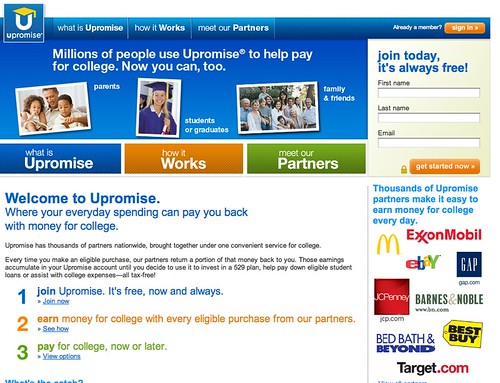
Upromise is marketed as a way to save money for your kids’ education. It is a subsidiary of SLM Corporation (“Sallie Mae”), the U.S. largest student loans company.

You essentially save by spending.  You get “1-25% back from eligible purchases from 600 online retailers”, “8% back from participating restaurants”, “1-3% on select items at grocery/drugstore”, “10% EXTRA on select items at participating grocery/drugstore and at Upromise dining restaurants; and 1% everywhere you shop when using the Citi Upromise World MasterCard”.

For online transactions, you have to start shopping at participating shops from the Upromise.com Web site (so that they can track your purchases) and for offline transactions, you have to register your existing Credit/Debit card or grocery/drugstore store loyalty card to your UPromise account, and Upromise uses this information to track your purchases and match them up with cash rewards from participating merchants. The privacy notice mentions that some programs might require additional information like Frequent Flyers mile numbers or telephone number.

Other members can be linked to the account, which makes the contributions from family and friends possible.

Upromise screenshot

For restaurant cash rewards, Upomise use Restaurant Cashback.

Comments

The service is essentially a compromise on privacy for value. I find the promise on rewards very high (“up to 25% on select items”) and would be curious to hear from people who have used the service.

I personally find the idea of “saving by spending” a bit ironic. I would imagine that people would save much more by not going to the restaurant in the first place or not buying that brand product and instead buying the white label product. But I can see that in some cases, the system works: for instance, cash-rich retired grand parents who, for good reasons, might want to enjoy brand products or nice restaurants, while helping their kids and grand-kids out.

In short, I’m really curious to hear from real participants with real success stories of having saved a significant portion of a student loan via this program.

I see more opportunity in smart savings programs built into Web services like Wesabe or Mint.com. For instance, assuming you’ve been to a restaurant several times you would see a message that would help visualize how much this money could represent by the time your kid gets in college, if you hadn’t been to this restaurant, or at the very least, if you had chosen a cheaper alternative nearby.