Reputation

I define having reputation as having reputable third parties willing to confirm one’s claims as true.

These claims include:

  • personal information such as one’s date of birth or first name, 
  • transaction information such as timely re-payment of debt following a credit card purchase, 
  • opinions expressed that are shared by others such as a blog post or 
  • actions done or not that are approved by others
  • artifacts produced that are appreciated by others

Whuffie 

Verifying someone’s claims used to be expensive and limited to a few players, such as credit bureaus in partnership with credit card networks. The recent computerization of communications has reduced the authentication cost by increasing the amount of authenticatable information (in the form of published opinion/thought pieces) and the potential number of authenticating parties, leading to my understanding of the concept of whuffie. 

Linking with attention 

I say “potential” because 3rd parties will not authenticate content unless one has their attention in the first place. Attention is limited the nature of people’s cognitive capabilities and is ideally dependent on their goals, but also a function of one’s reputation, which leads us to…

Social capital 

The self-reinforcing aspect of reputation together with each person’s limited attention and exploding amount of authenticable information is what explains social capitalism: the authenticable information created by some is republished by others and through this process fully/partly appropriated because of their reputation. This is similar to Marx’ capital where part of the value-add of workers’ labour is appropriated by employers because of their ownership of the productive asset.

Examples include bloggers or journalists who are given exclusive information before it is published because of their established trademark. They don’t need anymore to find a good story, only to filter it out from what they receive.

Attention is the new capitalistic asset to own, maybe the new money considering that people’s attention is limited and that it is dispensable by those with social capital.

(Side note: assuming attention is driven by goals (see Flow), owning attention is done by getting others to align their goals on one’s goals).

Privacy 

What is interesting about reputation is that it does not necessarily require information to be published. It only requires someone reputable to confirm it as true. I don’t need to tell you that I’m over 21 years old, but just need to point you to someone reputable that can confirm my claim.

In other words, privacy may not be dead, but it has to be dead with one or a few highly reputable parties.

The relation to OpenId and OAuth

It derives from the above that an OpenId or OAuth provider’s relevancy is proportional to its reputation. Its value is proportional to its ability to actually verify the information it hosts.

[Slashdot] [Digg] [Reddit] [del.icio.us] [Facebook] [Technorati] [Google] [StumbleUpon]

I wasn’t able to attend BankCampBankDallas, but Charlie over at Open Source CU wrote a nice report highlighting some of the concepts that were discussed during the camp:

  • Incorporating online reputation into financial reputation: “why can’t [FIs] hook into LinkedIn and view a person’s Recommendations and process that into their credit score”
  • Opening a FI’s APIs to the creativity of their customers and 3rd party developers: “could there ever be a day where an existing financial institution could let people hook into it and meaningfully tailor the infrastructure and product to their own needs?”

I think exploring the links between online reputation and financial reputation is very interesting indeed. I think leveraging public social data is a great way for banks to reduce the risk of payment default on people with less than perfect credit. I’ve talked about this before, particularly in the context of peer-to-peer lending: in the problem with banking innovation…, I explained how a loan where some of the people lending money are family members offers a different and more attractive risk profile than someone’s lending money from people they don’t know (and don’t care) about (especially when you have a huge securitization food chain). I had never thought that such data could eventually actually be part of the FICO score, and that I think that will take A LOT of time. Here is my guess at how things will evolve: I think that Experian-like services computing someone’s overall reputation (see how to compute someone’s whuffie) will develop, and as they become established brands, may end up as an input to FICO scores. Anyway, I do think FIs are fundamentally social intermediaries and can’t afford to ignore the publicly available social data. I think there is a great opportunity, especially at credit intermediaries whose goal is the benefit of the community (credit unions), to re-socialize credit relationships.

Regarding the opening of Banking Web APIs, I think also that this is a great way for FIs to smartsource innovation while ensuring the highest level of security standards. In the problem with banking innovation…, I suggested at the very end that one way to smartsource innovation could be to “do what Apple or Facebook do: expose some of this information via easy-to-use APIs in a way that is more secure than their startup competitors. Then, allocate a VC fund to fund startups using this API (which is equivalent to buy an option to invest more/buy out the most promising ventures later).”

So, I’m glad to see that these highlighted concepts are inline with some of my own ideas and probably with many other people. I really hope I can make it to the next BarCampBank near San Francisco.

[Slashdot] [Digg] [Reddit] [del.icio.us] [Facebook] [Technorati] [Google] [StumbleUpon]

Imagine yourself in a world where nanotechnology has made scarcity and the associated traditional form of money a thing of the past. In this world, the only currency is the goodwill that people give electronically to one another and everyone’s overall resulting reputation score is accessible by anyone in real-time. This reputation is Whuffie and the term and world was coined and imagined by Cory Doctorow in his sci-fi novel, Down and Out in the Magic Kingdom.

Fast rewind to present time. We are a world where people increasingly publish digitally their life i.e. are “life streaming”: they publish pictures, blog posts, twits, videos, wikis, etc. Other people subscribe to these life streams (RSS/friendfeed), give attention to the ones they find the most relevant and sometimes comment positively or negatively on these life stream items. These comments are themselves life streaming items and subject to views and positive/negative comments from others.

One thing is missing to get us closer to Cory’s vision: real-time computation of anyone’s Whuffie, the Web 2.0 equivalent of your FICO score. How do we compute it?

I have only found one blog post so far on the the problem of the so-called Whuffie algorithm, but I was not convinced by the arbitrary number of points won/lost for specific actions, and by the difficulty of implementing the tracking of some of these actions:

Trash talk somebody: -1000
For every conference you attend: +200 (Plus bonus +5 for each #tweet)

I know that Jeff Ward wrote that he was just posting for fun on this one, but since there seemed to be interest in the comments for an actual implementation, I decided tonight in BART to take a stab at what such algorithm would look like.

Here are the basic principles:

  • The algorithm should take into account how many positive/negative comments or citations your life stream items have got from other people, weighted by the Whuffie score of each of these people.
    • The use of the weight here is important as it allows to remove completely the arbitrary point amounts: for instance, instead of “For every conference you speak at: +10,000″, speaking at a conference would essentially be equivalent to posting a summary of your speaking engagement and have the conference organizers or the conference itself comment on it/cite you on their Web site, with the Whuffie value of the comment being a function of the Whuffie of the conference or conference organizers themselves.
    • The positive/negative nature of the comment would be determined via semantic analysis or microformats votelinks or voting nanoformats (vote:for:this article, +1/-1).
  • If the positive/negative nature of the comments cannot be determined, a positive Whuffie point amount of a lesser amount would be attributed, weighted by the Whuffie of the entity issuing the comment.
  • If no comment is available, views should be used (# of time a video was viewed), agained weighted by the Whuffie of who viewed it if possible. Views should contribute less Whuffie points then comments.
  • In all cases, for each item published a number of points should be provided multiplied by the number of followers the person/entity has on the site where the life stream item is posted on (# of subscribers to RSS feed, # of Twitter followers, # of Flickr contacts, etc.).

I don’t really have a precise idea of what these point amounts should be. Let’s say +10 for a positive comment, -10 for a negative comment, +5 for a comment, +3 for a view, and +1 for a published item.

Let’s also say that these points would be weighted by 1/100 of the Whuffie of the person commenting, viewing or following the publisher/life stream item. so, if my Whuffie is 1,000,000 and I view an image of someone, but do not comment on it, that gives 10,000 Whuffie points to the person who posted this image.

Of course this algorithm reduces the number of arbitrary constants to a few, but these are still arbitrary. So, the next question that came to my mind is whether there is a set of constant values that would be better than another, better for instance at achieving the goal of a Whuffie system.

What is such goal? do we want a bell curve distribution of Whuffie scores, a very spiky curve or a very flat curve. Do we want Whuffie to last indefinitely, or to self-destroy over time (with the objective of preventing social capital to be too concentrated among too few people). I think this is where I should have started, but that I will the subject of another post hopefully. In the meantime, I will get good ideas/suggestions from you.

Another interesting problem is how we fight spam and reputation hacking in such a system. I think one partial answer would be to allow Internet hosts to have their own Whuffie, and to use that as an additional weighting factor. Ideas here are welcome as well.

[Slashdot] [Digg] [Reddit] [del.icio.us] [Facebook] [Technorati] [Google] [StumbleUpon]

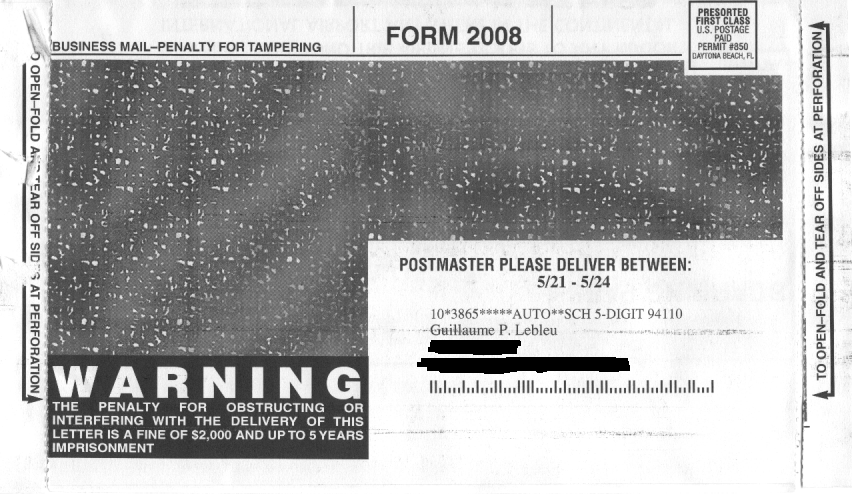
I recently received a pretty aggressive form of spam from a company based in Concord, CA. The outside was designed to look like some highly confidential and urgent material of legal and/or financial content. For instance, you could read on the front: “WARNING The penalty for obstructing or interfering with the delivery of this letter is a fine of $2,000 and up to 5 years imprisonment”.

envelope cover

As I opened it, I was genuinely worried, but quickly discovered it was just some kind of “Free offer* (*well, not really)” from a company called “Pulaski Tickets and Tours” based in Concord, CA according to the content of the spam. A Google query returned that the company is actually based in New York state and headed by a man named Patrick Harthough who lives here. The address in Concord is probably the address of a trash box for complaints.

Like most people, these types of mail waste my time (I shred any mail that is irrelevant) and now abuse my emotions.

I’d like to be able to do a little more than be able to trace this person and his company. I’d like to essentially publish somewhere, in a form that can be easily found and searched by others that this person’s marketing practices are questionable. This way, Mr. Harthough’s reputation is public and if enough people can easily do the same rather then just writing in forums, then people like me could automatically discard Mr. Harthough’s mails and perhaps people like Mr. Harthough would change their practices.

This type of real-time rating system is something I’ve been personally interested for many years, particularly as it applies to the hidden social and environmental costs of products people buy and use their social network of usually like-minded people to re-balance the current asymmetry of power between consumers and marketers. I think we are getting pretty close to a point where this type of system can be implemented (the technology of software UPC barcode scanners is getting to a point of usability, social networks are omnipresent, and Web-wide data queryability about companies and people is also making progress).

I recently discovered that a generalized version of this concept has a cool name: Whuffie, and that a book by Tara Hunt is coming out on the subject later this year.

[Slashdot] [Digg] [Reddit] [del.icio.us] [Facebook] [Technorati] [Google] [StumbleUpon]